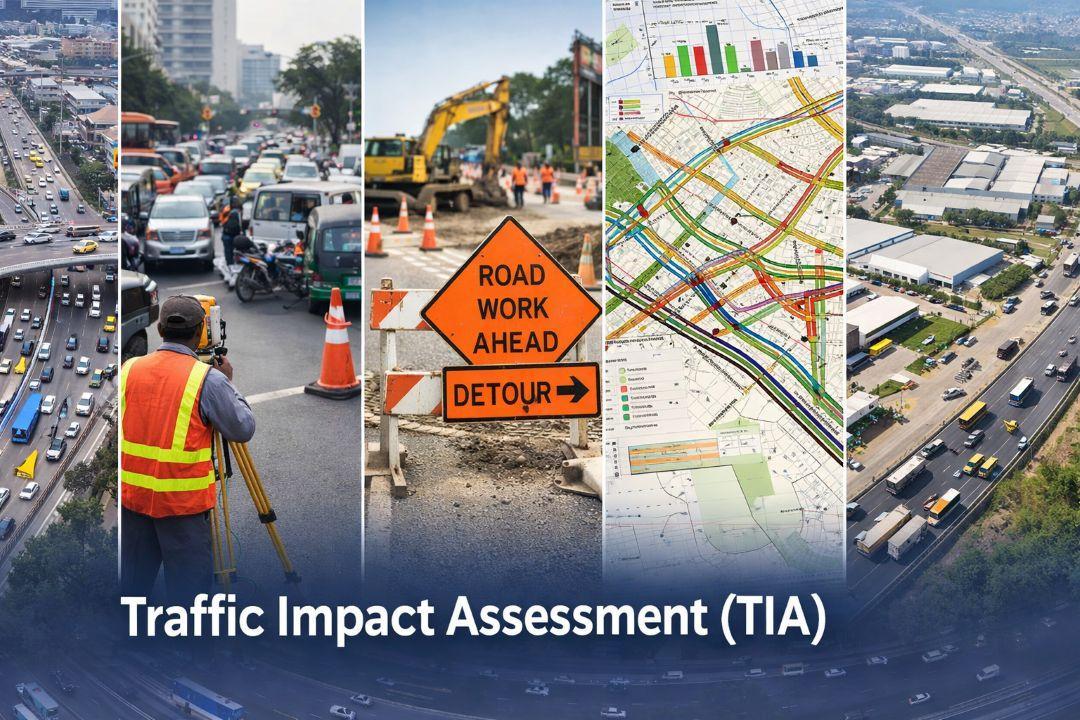
Traffic Impact Assessment
Overview
Traffic Impact Assessment (TIA) is a systematic study conducted to assess how a proposed development will affect the surrounding road network, traffic flow, pedestrian safety, and overall transportation performance. Our TIA services support sustainable infrastructure planning, regulatory compliance, and risk minimization during both construction and operational phases of projects.
We conduct TIA studies in accordance with DoE, BEZA, RAJUK, RHD, LGED, City Corporation guidelines, and international best practices where required.
Scope of Traffic Impact Assessment Services1. Baseline Traffic Study
Existing road network inventory and classification
Traffic volume counts (peak & off-peak hours)
Turning movement counts at junctions
Pedestrian and non-motorized traffic assessment
Public transport and freight movement analysis
Road safety audit of surrounding areas
2. Traffic Demand & Trip Generation Analysis
Trip generation and attraction estimates
Modal split assessment (private, public, NMT, freight)
Traffic distribution and assignment modeling
Peak hour factor and growth rate analysis
Future traffic scenario development
3. Capacity & Level of Service (LOS) Analysis
Intersection and corridor capacity evaluation
Level of Service (LOS) assessment
Queue length and delay analysis
Bottleneck identification
Network stress and saturation analysis
4. Construction Phase Traffic Impact Assessment
Construction traffic volume estimation
Haul route identification and optimization
Material transport and heavy vehicle impact analysis
Temporary traffic diversion planning
Construction safety and access management
5. Operational Phase Traffic Impact Assessment
Long-term traffic load assessment
Parking demand and supply analysis
Internal circulation and access design review
Emergency vehicle access evaluation
Freight and service vehicle movement planning
6. Traffic Management & Mitigation Measures
Traffic Management Plan (TMP) preparation
Junction improvement recommendations
Signalization and road geometry improvements
Access control and median treatment proposals
Parking management strategies
Pedestrian and cyclist safety enhancements
7. Environmental & Social Integration
Traffic-related air and noise impact linkage
Road safety risk mitigation
Community access and mobility planning
Stakeholder consultation support
Integration with EIA / ESIA / EMP studies
There are many variations of passages of Lorem Ipsum available, but the majority have suffered alteration in a our some form, by injected humour, or randomised words which don't look even slightly believable. If you are going our as to use a passage of Lorem Ipsum, you need to be sure there isn't anything embarrassing hidden in the middle the of text. All the Lorem Ipsum generators on the Internet tend.